How to Choose an Ergonomic Chair in Singapore
The features that actually matter in an office chair, the adjustment figures ergonomists use, and why the desk you pair it with matters just as much.

Most people buy the chair that looked best in the photos, sit in it for a week, and quietly go back to aching by Wednesday. The problem is rarely the price. It is that the chair was never matched to the person, and no showroom lighting can fix that. So before you compare brands, it helps to know what an ergonomic chair is actually for, which adjustments earn their keep, and how to tell quickly whether one fits you. That is what this guide covers, and it ends where most chair guides never go: the desk you put the chair under.
What makes a chair ergonomic
An ordinary office chair holds you up. An ergonomic one lets you change how it holds you up, because no two bodies fold at the same points. The features that matter are the ones you can move: a backrest that supports the lower spine, a seat that sets your feet and thighs correctly, and armrests that carry your forearms so your shoulders can drop.
The word to weigh against is "adjustable". According to OSHA, a good chair's backrest conforms to the natural curve of the spine and provides height-adjustable lumbar support, and increased adjustability is what ensures a better fit for the user. Fixed features look tidy on a spec sheet and betray you the moment your proportions differ from the average the factory designed around. When you read a listing, count the things that move, not the things that are named.

Start with fit, not the brand name
Fit is measurable, and it is where you should start. Sit all the way back and look at your legs. CCOHS advises setting the seat height so the highest point of the seat, held level, is just below your kneecap, with your feet flat on the floor. If your feet dangle or you tuck them under the chair, the seat is too high; if your knees ride above your hips, it is too low.
Then check the depth. Slide a hand behind your knee: CCOHS suggests the clearance between the front edge of the seat and your calves should fit a clenched fist, about 5 cm. A seat that presses into the back of your knees cuts off the very support it promises, which is why OSHA says the seat pan should support most of the thigh without contact behind the knee. Bodies vary more in torso and leg length than in height, so a chair that fits your colleague may not fit you at all. Judge the chair by your own measurements, not the review score.
Lower-back support that lands where it should
Lumbar support is the feature most often sold and least often set. A curve moulded into the backrest is worthless if it lands between your shoulder blades or below your belt. The point is placement. CCOHS recommends adjusting the backrest forwards, backwards, up and down so it fits the hollow of your lower back, the inward curve just above your waistband.
This is why a height-adjustable lumbar system beats a fixed lump of foam, and why you should distrust any chair that offers only one. Sit against it. You should feel the support arrive in the small of your back and hold you there without pushing you forward. If you cannot move it to meet your spine, the chair has decided your posture for you.
Armrests, the seat edge and the small adjustments
Armrests exist to take the weight of your arms off your neck and shoulders. Set them, do not just accept them. CCOHS describes sitting upright with your arms loose, bending your elbows to about a right angle, and raising the armrests until they barely touch the undersides of your elbows. Set too high, they hike your shoulders; too low, and you lean. OSHA adds that armrests should support the lower arm while keeping the upper arm close to the torso.
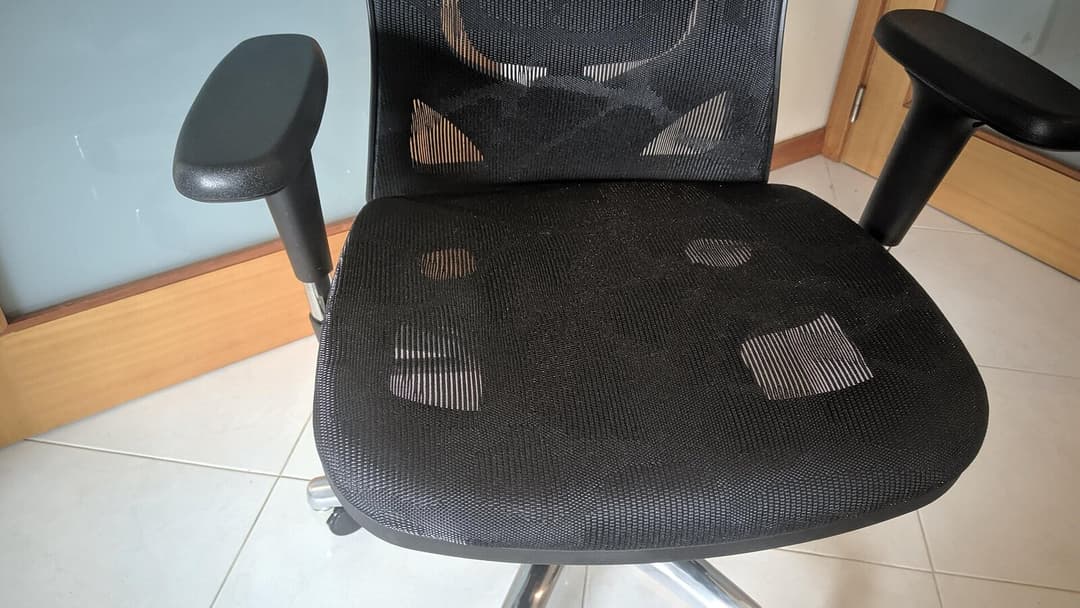

The small things add up. A front edge that curves down gently, rather than a hard lip, keeps pressure off the underside of your thighs. Armrests that only move up and down are worth less than ones that also slide in and pivot. None of this shows in a thumbnail, so it pays to read the adjustment list closely before you fall for a colour.
Mesh and Singapore's climate
There is one Singapore-specific point worth its own paragraph: heat. A dense foam-and-fabric seat traps warmth against you through a long afternoon in a flat that is not always air-conditioned. A breathable mesh back and seat let air move, which is why so many chairs sold here lead with mesh. Run your hand across it in the showroom and press in. Good mesh is taut and springy, not slack, and it should hold its tension across the whole seat rather than sagging in the middle after a firm push.
Mesh is not automatically better than a well-made cushioned seat, and a cheap loose weave can dig a ridge into your legs. But in a warm, humid home it earns its place, and it is the first thing worth feeling for when you sit down.
Try it before you commit, and check the build
An ergonomic chair is one of the few things worth buying with your body rather than your eyes. If you can, sit in it properly for a good stretch, not the quick perch most people give it. Run through the adjustments in order: seat height, seat depth, backrest, lumbar, armrests. A chair that fights you in the showroom will not soften at home.
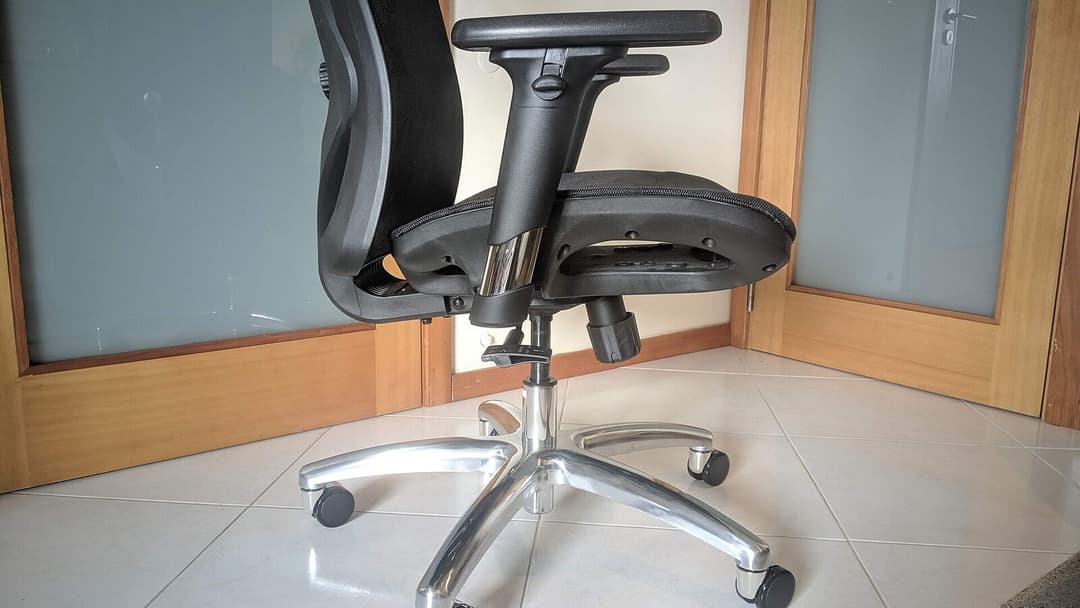
While you are there, look underneath. A wide five-star base resists tipping, castors suited to your floor roll without gouging it, and a smooth gas lift tells you the mechanism was not built down to a price. Check the stated weight rating against your own, with a margin. Buying in person also settles the boring questions that matter later: warranty length, and who collects the chair if something fails.
A chair is only half the setup
Here is what the buying guides skip. A perfectly set chair sits under a desk, and if the desk is the wrong height the chair cannot save you. Once your elbows are at about a right angle in the chair, the desk should meet your hands at that same level so your wrists stay flat. On a fixed desk you adjust the chair and then prop your feet or crane your arms to reach the surface. On a height-adjustable desk you set the chair to your body first, then bring the desk to meet it. Our desk height calculator and our standing desk height guide walk through the numbers.

The other half is movement. OSHA notes that a good upright posture keeps the torso and neck roughly vertical, the thighs roughly horizontal and the lower legs vertical, but it also warns that no single posture is healthy for long, so you should change position frequently through the day. The best chair in the world still wants you to stand up now and then, which is the real argument for a desk that rises with you.
That is where the Vival Desk fits. It is a dual-motor sit-stand desk in a walnut finish that rises and lowers to meet whatever chair you have chosen, so you can set the chair to your body and the desk to the chair. It arrives flat and most people finish assembling it on their own in about 30 to 45 minutes, roughly the effort of a piece of IKEA furniture, as our FAQ sets out. Delivery is free across Singapore and, per our shipping page, most orders arrive within two to five working days. S$289 with code VIVAL60 (list S$349)
Choose the chair with your body, set every adjustment it offers, and give it a desk that can move. Get those two right together and the aching Wednesday never arrives.