Do Standing Desks Work? What the Research Shows
Standing desks cut sitting time, but the health claims are smaller than the hype. Here is what independent research actually found, limits and all.
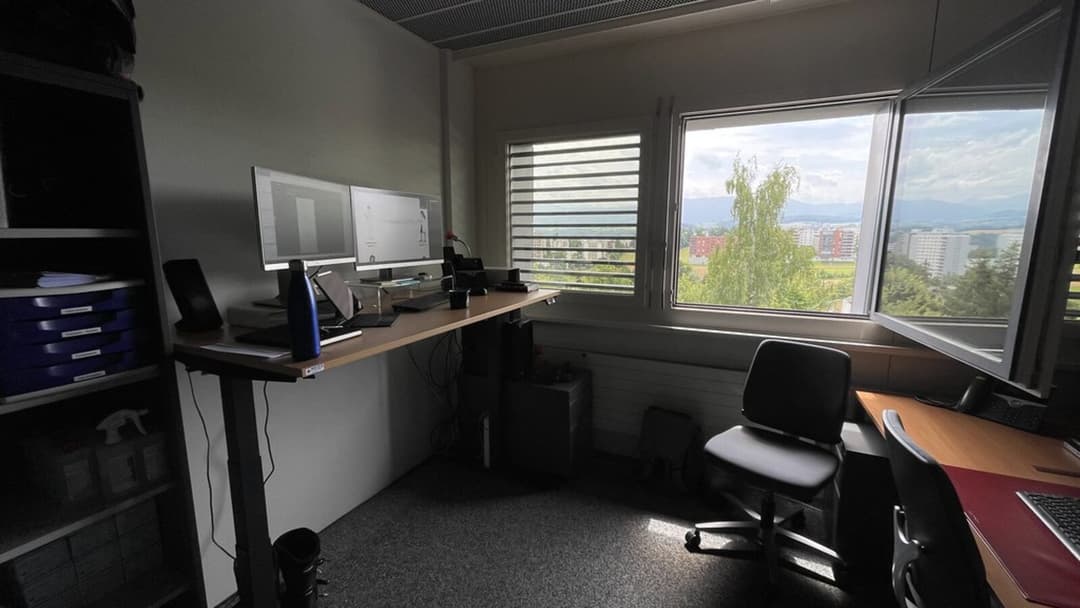
Ask whether a sit-stand desk is worth buying and you are really asking a health question. Does trading some of the day's sitting for standing change anything a body notices, or is it a nicely marketed way to spend money? The honest answer from independent research is a qualified yes, followed by a longer list of maybes. One thing is reliable: people who have a sit-stand desk sit less. The bigger promises, about weight, focus and disease, are weaker, and a couple carry cautions of their own.
This is general information, not medical advice. If you have back or neck pain that will not settle, please see a doctor or physiotherapist.
What the question is really asking
A sit-stand desk, also called a height-adjustable desk, raises and lowers so you can work seated or standing and move between the two through the day. When people ask whether standing desks work, they usually mean one of two things: will it help my back, and is it good for my health?
To weigh either, it helps to name the problem a standing desk is meant to solve. That problem is sedentary time, the long unbroken stretches of sitting that fill most desk jobs. Being sedentary is not the same as being unfit; you can run at the weekend and still spend the working week almost motionless in a chair. A standing desk is one tool for breaking up that stillness. Whether it earns its place depends on what the evidence actually shows it does, and what it does not.
Start with what Singapore and the WHO recommend
Before any single desk, start with the public-health advice, because it frames everything that follows. The Health Promotion Board's Singapore Physical Activity Guidelines recommend that adults do at least 150 to 300 minutes of moderate-intensity aerobic activity a week, and that we all find ways within daily routines to move more and break up sedentary time.
The World Health Organization's 2020 guidelines say much the same: adults should do at least 150 to 300 min of moderate activity a week, and reducing sedentary behaviour is recommended for every age group. Notably, the WHO found the evidence insufficient to set a number of sedentary hours as a threshold. There is no official "sit no more than X hours" line, because the research cannot yet support one. The through-line in both is movement and variety, not posture for its own sake. A standing desk only matters insofar as it helps you sit less and move more.
What a standing desk reliably does: you sit less
This is the claim with the strongest support. A Cochrane review of 34 studies and 3,397 participants found that sit-stand desks reduced sitting at work by about 100 minutes a workday in the first three months, and by about 57 minutes a day at three to twelve months. The reviewers rated the evidence low quality, and they were careful to add that there is no evidence on effects over longer follow-up periods than a year.

A large year-long trial fills in the picture, and it holds a useful warning. In the SMArT Work trial of 146 office workers, the thing that was tested was not a desk on its own. It was a package: a height-adjustable workstation plus a seminar, sitting and standing targets, feedback, posters, goal setting and regular coaching. That package cut occupational sitting by an adjusted 83.28 minutes a workday at twelve months, with no difference in sick days between groups. The lesson is that the desk is the easy part. The behaviour around it, the nudges and the habit, is what moved the numbers.
Standing burns a little more, but not much
The weight-loss pitch is where the gap between hope and evidence is widest. A meta-analysis of 46 studies found that standing uses only a little more energy than sitting, about 0.15 kcal a minute, which the authors work out to about 54 extra kcal a day for a 65‐kg person who spends 6 h a day standing instead of sitting. Even then, they describe the resulting effect on body fat as a projection that still needs testing, not a result they measured.
Put plainly, standing instead of sitting is not exercise and will not, on its own, change the scale. If a page tells you a standing desk burns the calories of a snack or melts fat over a year, treat that as marketing rather than measurement. The energy difference is real but small.
Back, neck and comfort: softer, smaller evidence
Comfort is where many people feel the difference first, and it is where the evidence is friendliest, though still modest. A scoping review of 53 studies found that sit-stand desks reliably change what office workers do, change health measures only mildly, and help discomfort more than anything else. The same review found the weakest evidence of all for work performance.
Worth saying clearly: much of the back and neck research is small, short and based on what people report rather than on a clinical measure. Those studies point in a hopeful direction for aches tied to long sitting, but they are a long way from proof that a desk treats back pain. If your pain has a specific cause, a desk is not a substitute for a clinician.
What the research has not shown
The honest parts are as important as the hopeful ones, and they build trust. Several popular claims have not been established. The productivity boost is the clearest example: the scoping review above found the least support of all for work performance, so a standing desk is not a reliable way to get more done. There is no evidence that the sitting-time benefit lasts beyond about a year, because the trials simply have not run longer. The WHO could not set a safe number of sedentary hours. And no study has shown that a standing desk lowers the risk of heart disease or of dying earlier. Where a claim is not supported, the grown-up position is to say so.
The catch: standing all day is not the fix
There is a tempting next thought, that if some standing is good, all-day standing must be better. The evidence says otherwise. A UK Biobank study that followed 83,013 adults found no link between standing time and cardiovascular disease, which is reassuring, but it also found that more standing across the day was linked to more circulation and vein problems, with the risk edging up for every additional 30‐min increase in standing time beyond about 2 h a day. Very long daily sitting, meanwhile, was linked to both. Standing all day swaps one problem for another.


What matters more than the posture is the movement. A pooled analysis of more than a million people found that high levels of moderate activity, about 60 to 75 min a day, appeared to eliminate the increased risk of death linked to long sitting. So the honest framing of a standing desk is not "stand to be healthy" but "sit less, stand sometimes, and move often". The desk is a prompt to change position, not a cure for a still life.
How to use one, if you try it
If you decide to try standing at work, build up to it. An expert statement on the sedentary office advises office workers to add standing and light activity gradually through the day rather than standing all at once, and it is candid that this advice rests on observational and short-term studies rather than long trials.
Set the desk up properly when you are standing. The Canadian Centre for Occupational Health and Safety advises keeping your elbows close to the body and bent at about 90 degrees, with the work surface at roughly standing elbow height, the same as when you sit. It also suggests supportive footwear, an anti-fatigue mat and a footrest to shift your weight on. If you want the numbers for your own height, our desk height calculator works them out, and our guide to building a standing desk routine that lasts covers the habit side.
Where the Vival Desk fits in
So, do standing desks work? For the one thing they are built to do, helping you sit less across the day, yes, modestly and if you use them. Beyond that, keep your expectations in line with the evidence, and treat the desk as one part of moving more.
The Vival Desk is one such sit-stand desk. It moves between a seated and a standing height, from 72 to 120 cm, on two motors, and three one-touch presets with a lit height readout let you return to the same positions with a single tap. Two motors are what make that change smooth under a loaded top; there is more on why that matters in our guide to dual-motor standing desks. Delivery is free across Singapore and usually lands within two to five working days, and most people put the whole thing together in about 30 to 45 minutes. If a sit-stand desk earns a place in your home, you can see the full specification on the Vival Desk product page.