The Bauhaus and What It Means for a Desk
A plain-English look at what the Bauhaus was, Dieter Rams's ten principles of good design, and the questions they give you for judging a working desk.
Most desks are sold on a number. Price, height range, how many kilograms the top will hold. Far fewer are sold on whether they are any good as design. In 1919 a German school opened that spent its short life arguing about exactly that, and the way it answered still gives you a useful lens for the desk in front of you today.


What the Bauhaus actually was
The Bauhaus was a school. On the Tate's art-term page, read in October 2026, it is described as "a revolutionary school of art, architecture and design established by Walter Gropius at Weimar in Germany in 1919". The name joins the German words for building and house.
What set it apart was its aim. In the Tate's words, that aim "was to bring art back into contact with everyday life", and the school gave "architecture, performing arts, design and applied arts" as much weight as fine art. A chair or a lamp was treated as work worth the same care as a painting.
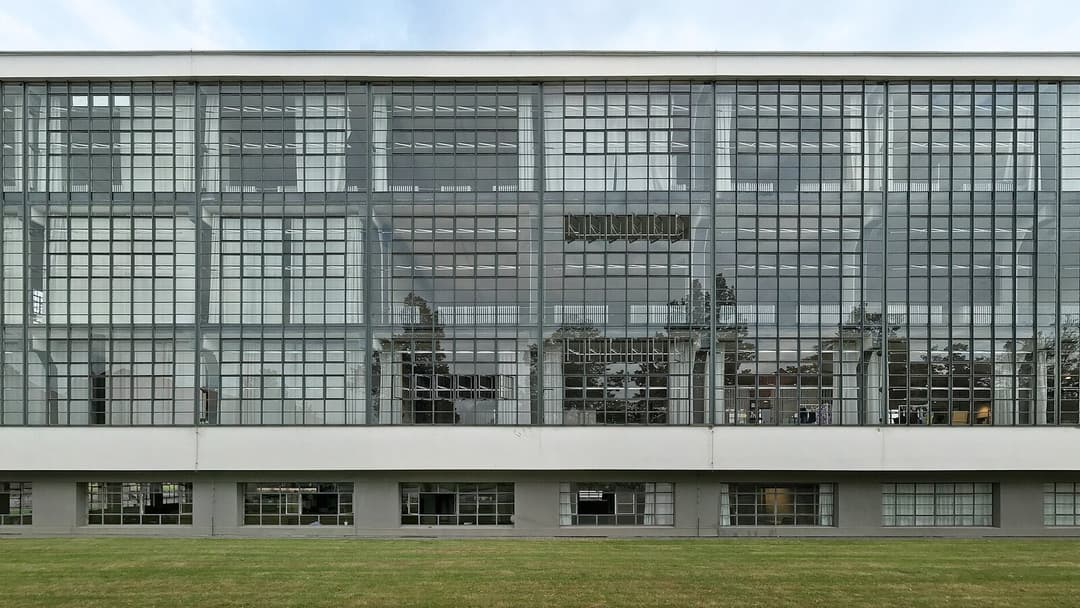
The school did not stay in one place. According to the Tate, it moved from Weimar to Dessau in 1925 to 1926, where Gropius built a new home for it, and in 1932 it moved to Berlin, where it was closed in 1933. The building below is that Dessau home, with its glass workshop wall.

The idea that outlived the school
A school that lasts from 1919 to 1933 is a short life. The reason the Bauhaus still matters is the idea it left behind, not the few years it ran.
That idea was simple to state and hard to live by. If design and applied arts deserve as much weight as fine art, as the Tate puts it, then the everyday object has to be taken seriously. A table is not decoration bolted onto a frame. It is a thing to be worked out from its job backwards.
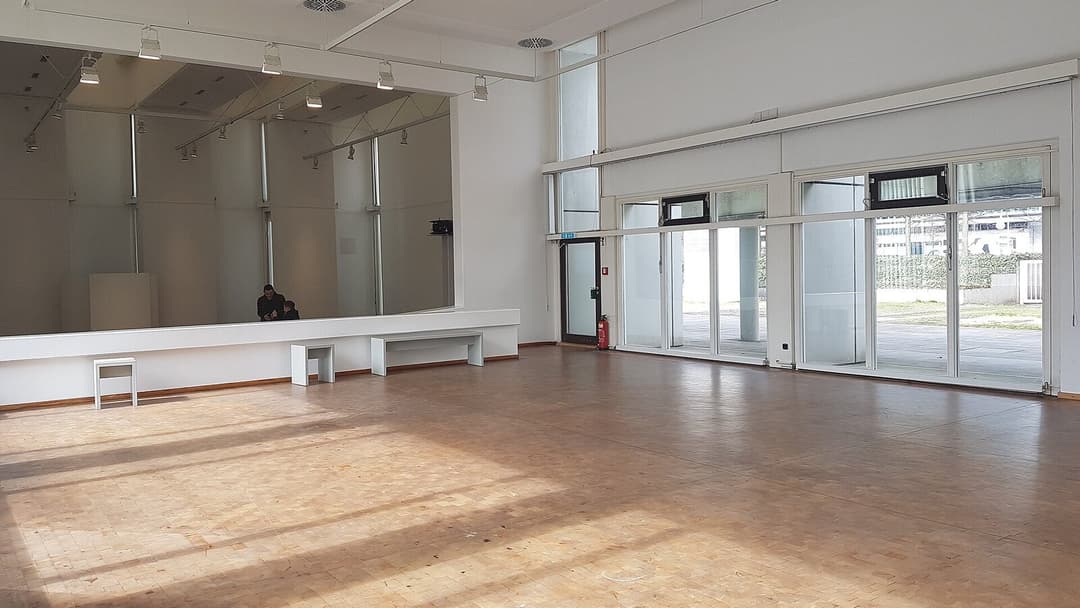
The teaching carried this through its people. The Tate records that teachers "included Wassily Kandinsky, Paul Klee, László Moholy-Nagy and Josef Albers". When the school closed, those people scattered, and the habit of judging an object by how honestly it does its job travelled with them. The same plain spaces, bare materials and visible structure show up wherever that habit landed.

Dieter Rams and less, but better
To turn that habit into something you can use on a Saturday in a showroom, it helps to borrow a later checklist. Dieter Rams wrote one.
According to Vitsoe, read in October 2026, Rams was born in 1932, applied for a job at Braun in 1955 and "was appointed head of design at Braun in 1961, a position he held for the following 34 years". The same page records how he summed up his approach: "Less, but better."
Rams is not a Bauhaus figure. What he did was put the same instinct, judging an everyday object by how well and how honestly it works, into a short list. Vitsoe publishes that list as his ten principles of good design, and the tenth reads: good design "is as little design as possible". The rest give you a way to ask the question about a desk.
Ten questions to ask of a desk
Vitsoe sets out Rams's ten principles. Reordered with the ones closest to a plain working desk first, each becomes a question you can put to anything you are about to buy.
1. Is it useful? Vitsoe states that good design "makes a product useful". For a desk that is the first test. Does the height range fit the people who will sit and stand at it, and is the surface deep and wide enough for the work you actually do?
2. Is it honest? Vitsoe states that good design "is honest": it "does not make a product more innovative, powerful or valuable than it really is". Ask whether the maker names the material plainly. Our own FAQ, for example, states that the top is a walnut-look laminate, which is a printed surface layer bonded onto the board, over a core of MDF, that is medium-density fibreboard, a board pressed from wood fibre, rather than describing it as solid wood. If you want to understand what that choice means for a surface, we go into it in engineered wood versus solid wood.
3. Is it long-lasting? Vitsoe states that good design "is long-lasting" and "avoids being fashionable". Ask what is built to be serviced and what is covered. Our desk, for instance, carries a one-year warranty on the motor and drive system, which tells you which part the maker expects to stand behind.
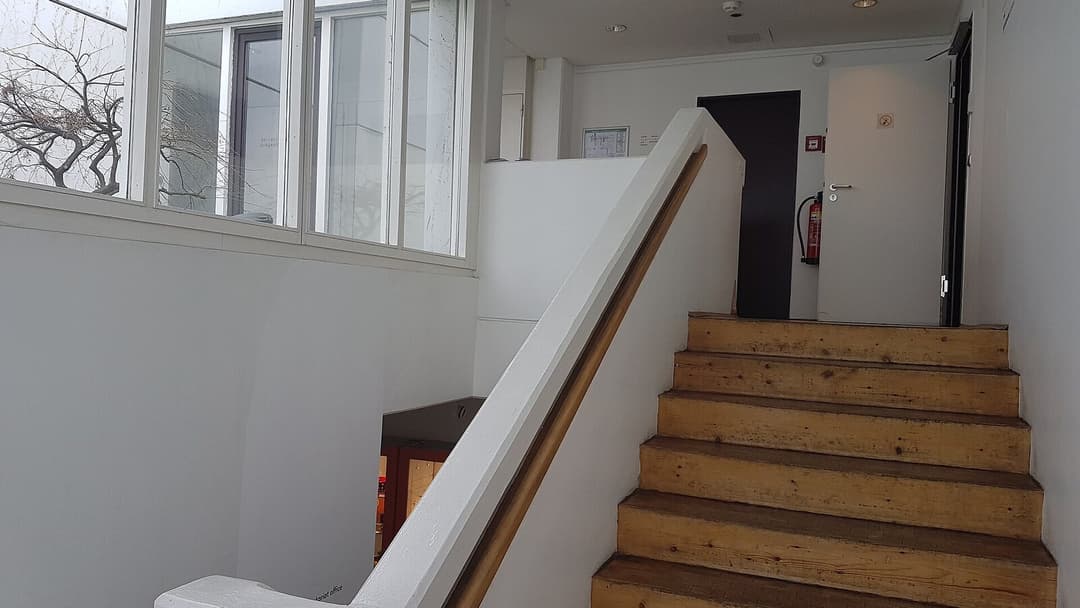
4. Is it thorough down to the last detail? Vitsoe states that good design "is thorough down to the last detail". On a desk that means the edges, the way cables are routed, and how the frame meets the top. The Bauhaus taught people to leave the structure visible, as the bare treads and plain handrail below do.

5. Is it unobtrusive? Vitsoe states that good design "is unobtrusive" because products are "like tools" and "neither decorative objects nor works of art". A desk should recede into the room once you are working, not compete with it.
6. Is it understandable? Vitsoe states that good design "makes a product understandable", because "it clarifies the product’s structure". A height display you can read and presets that behave the way you expect pass this test. A control panel you have to relearn each morning does not.
7. Is it as little design as possible? Vitsoe states the tenth principle as good design that "is as little design as possible", because "less, but better". Ask whether every feature earns its place. Memory presets and a digital readout are useful to some people and clutter to others, so weigh them against how you will really work.
8. Is it aesthetic? Vitsoe states that good design "is aesthetic" because "the aesthetic quality of a product is integral to its usefulness". A surface you are glad to sit at every day is doing part of the job, not none of it.
9. Is it innovative? Vitsoe states that good design "is innovative", while noting that innovation "always develops in tandem with innovative technology". For a desk this is modest: a quiet, steady motor system is worth more than a novelty you will never use.
10. Is it environmentally friendly? Vitsoe states that good design "is environmentally friendly" and "conserves resources" across a product's life. A desk that lasts, and whose parts can be replaced rather than binned, answers this better than one you will throw away in a year.
Reading a desk's own facts honestly
The questions above are only as good as the facts you can check. This is where a desk's published page earns its keep.

Before you weigh any of this, write down what the maker states in plain numbers, then hold the object against them. Dimensions and height range tell you whether it is useful for your body and your room. The stated load tells you what it is built to carry. The material wording tells you whether the maker is being honest, and the warranty tells you what they will stand behind.
Our own Vival Desk is written up the same way, so you can read it as a worked example. It is a 120 by 60 cm top with a height range of 72 to 120 cm, rated to carry up to 100 kg, on a reinforced metal frame with two-stage telescoping legs, meaning each leg slides through two sections, driven by a dual-motor system. The top is a matte, low-glare walnut-look surface over an engineered-wood core, which is a board made from wood pressed and bonded together, designed in Singapore. If the surface itself is the part you care about most, how to choose a desk top takes it apart in detail.
One last honest number from our side of the counter. Our FAQ states that most people finish assembling the desk in about 30 to 45 minutes, and that one person can do the whole job alone. A desk that goes together simply, and comes apart the same way when you move, is quietly answering the long-lasting question too.
Using the questions when you shop
You do not need to memorise ten principles to use them. In a showroom, run a hand along the edge, read the display, and ask what the top is made of and what is covered. Online, open the specification and the warranty before you open the gallery. If a page will not tell you plainly what the surface is, treat that as an answer in itself.
Once the desk passes, the next question is the seated set-up: how the chair meets the desk, and the height your arms want. We cover that in office chair height for your desk.
The Vival Desk is our one desk, built to be read against exactly these questions. S$289 with code VIVAL60 (list S$349)